
September 2026
TRAINING WORKSHOP ON UNIVERSAL JURISDICTION
On 27 September, Aakash Chandran, AJC's Senior Law and Advocacy Manager, participated in a workshop organised by the International Commission of Jurists 'From Documentation to Accountability', and delivered a training on 'Universal Jurisdiction and Strategic Accountability' to Myanmar lawyers and human rights practitioners. The session focused on the legal and practical application of universal jurisdiction, including jurisdictional and evidentiary considerations, opportunities and challenges in pursuing UJ cases, the role of legal practitioners and human rights documenters, and strategic considerations in linking documentation with potential accountability proceedings.
ILA WEBINAR ON CRIMES AGAINST HUMANITY CONVENTION
On 23 September, AJC’s Executive Director, Dr. Priya Pillai, participated in an introductory webinar hosted by the newly established International Law Association Committee on the Development and Adoption of the Convention on the Prevention and Punishment of Crimes Against Humanity. The Committee includes Dr. Leila Sadat and Dr. Olympia Bekou as the Co-chairs, and Dr. Priya Pillai and Christopher Lentz as the Co-Rapporteurs. To read the mandate of the Committee, check here.

BLOG POST ON DR. YUSRA SUEDI’S BOOK
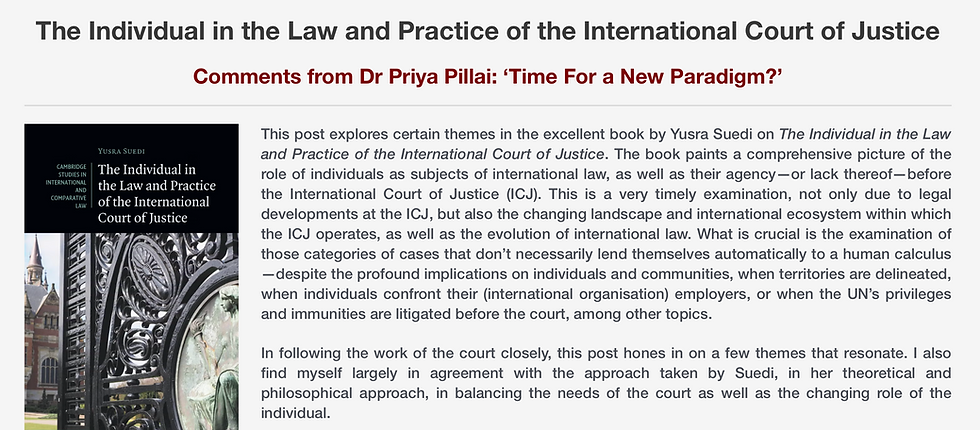
Dr. Priya Pillai contributed a post 'Time for a New Paradigm' to the symposium on Dr. Yusra Suedi’s book, ‘The Individual in the Law and Practice of the International Court of Justice’ hosted by CIL Dialogues. In her post, Dr. Pillai questions what makes the ICJ’s truly unique? Should a strict adherence to being state centric—with all its restrictions—be the essential defining feature of the ICJ, or rather, a court that can adapt to the unique times that it finds itself in, in order that such formalism does not come at the cost of its legitimacy?
AJC PARTICIPATES IN THE REDRESS’ IMMUNITIES WORKSHOP
From 10 – 11 September, AJC’s Senior Law and Advocacy Manager, Aakash Chandran, participated in a two-day conference and workshop, ‘Immunities for International Crimes’, in The Hague, Netherlands, focusing on personal and functional immunity in criminal proceedings both at the national level and before international tribunals. The event aimed to identify opportunities and develop strategies to encourage a continuation of the progressive development of international law and practice towards the non-applicability of immunities in criminal proceedings for international crimes committed by heads of State and foreign officials, including under the future Crimes Against Humanity Convention.